
Temples and upper face
A loss of soft-tissue support can change the transition between the forehead, temples and cheeks.
A facial consultation is a considered starting point if you have noticed changes in facial volume, proportion, lines, skin quality or overall balance. We assess your face as a whole, then talk you through the treatment pathways that may suit your concerns, goals and anatomy.
The face changes gradually through adulthood. Skin, collagen, elastin, facial movement, soft-tissue support and natural bone structure all contribute to how the face looks over time.
Genetics, sun exposure, smoking, sleep, stress, weight change and hormonal change can all influence how and when those changes become noticeable. Additionally, perimenopause and menopause can involve shifts in oestrogen that may affect skin hydration, elasticity and collagen structure.
Collagen is a structural protein that helps give skin firmness and resilience. Its production and organisation change over time, which can contribute to fine lines, skin laxity and a different quality of support through the face.
A consultation looks beyond collagen alone: a concern may relate to skin quality, movement, facial shape, tissue support, loss of volume or a combination of factors.
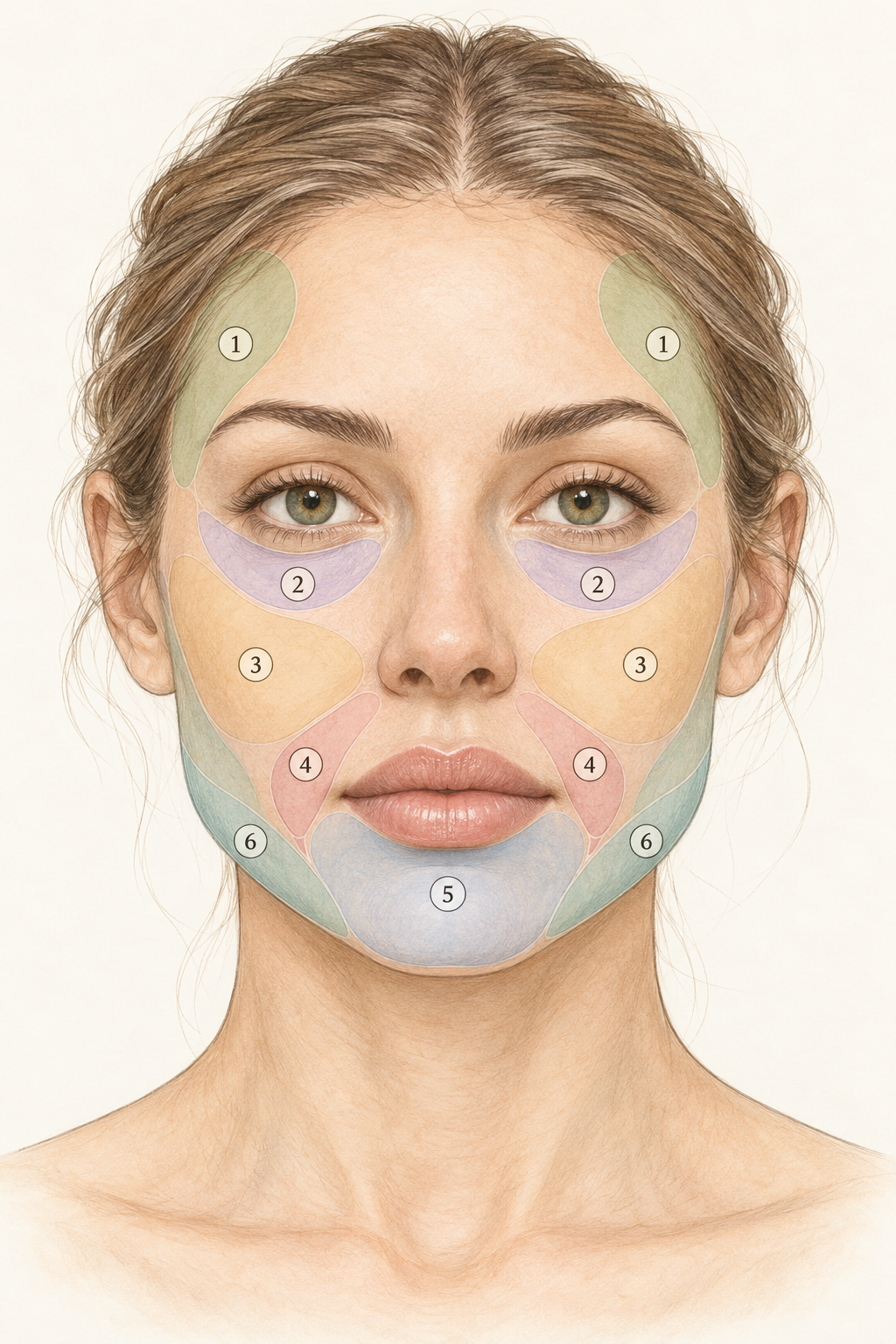
A concern in one area can be influenced by facial structure, soft-tissue support, movement and skin quality elsewhere. We assess the features you notice in relation to the rest of your face.
Loss of volume describes a gradual change in the soft tissues that support the face. It may be noticed as flatter cheeks, temple hollowing, a more shadowed under-eye area or deeper folds around the mouth.
It is rarely isolated to one point. We consider the relationship between the upper, mid and lower face so the concern can be understood in context.
A loss of soft-tissue support can change the transition between the forehead, temples and cheeks.
Changes through the mid-face can affect how the cheeks, folds and lower face appear together.
Hollowing, shadowing, skin quality and cheek support can all contribute to a tired-looking eye area.
Folds around the mouth may relate to movement, skin quality, facial support or changes in volume over time.
Reshaping refers to assessing how individual features sit within the wider face. The aim is to understand the concern and your preferences, not to prescribe one approach for every person.
Lip shape, symmetry, border definition and age-related change are assessed in relation to the rest of the face.
Profile balance is considered alongside facial proportions, not as an isolated feature.
Chin projection, lower-face proportion and jawline balance are reviewed as part of whole-face planning.
A consultation brings together the areas you notice with your anatomy, movement, skin quality and goals.
You do not need to know the name of a treatment before booking. Start with what you have noticed and what you would like to explore.
Lines, facial movement, skin quality, temple change and overall upper-face balance.
Hollowing, shadows, cheek support, facial folds, fine lines and skin-quality concerns.
Shape, proportion, profile balance, lower-face support and lines or folds around the mouth.
Skin quality may be part of the picture, or the primary concern in its own right.
Your Avesa practitioner begins with the whole picture: your concern, medical history, facial anatomy, skin, previous procedures and the recovery you can allow for.
You can bring one concern or ask for a broader facial assessment. There is no need to arrive having chosen a treatment.
We review movement, proportion, skin quality, tissue support, medical history and previous procedures together.
We will talk you through the pathways, recovery considerations, risks, limitations, timing, pricing and next steps relevant to your consultation.
Choose the area or concern that is most relevant to you, or simply ask for guidance. Our team will contact you to arrange the right next step.
No. The consultation starts with your concern, facial anatomy, skin and goals. Your Avesa practitioner will then explain the treatment pathways that may be appropriate after assessment.
Loss of volume describes gradual changes in facial soft-tissue support, often seen through the temples, cheeks, under-eye area or around the mouth. Reshaping considers how features such as the lips, nose, chin and jawline relate to overall facial proportion.
Yes. Facial movement, skin quality and facial balance are assessed together so your practitioner can explain the pathways that may be relevant to your concern.
Yes. Many facial concerns overlap. Looking at adjacent areas together helps us understand whether skin quality, facial support, movement, volume change or another factor may be contributing.
Yes. These are common areas raised during a facial consultation. Your Avesa practitioner will consider the relationship between your features and your overall facial balance.
Yes. Fine lines, texture and elasticity may be part of the concern. We can discuss skin-quality options such as Rejuran, skin-tightening pathways or whether another assessment would be more useful.
Hormonal changes can affect skin hydration, elasticity and collagen structure. Your Avesa practitioner can consider this alongside other factors such as age, sun exposure, medical history and your goals.
Your consultation considers your concern, medical history, facial anatomy, skin, previous procedures, goals and the recovery you can allow for. Risks, limitations and alternatives are also explained before you decide.
These depend on the concern, treatment area and recommended pathway. Your Avesa practitioner will explain relevant recovery considerations, timing, limitations, risks and pricing during your consultation.
This depends on the assessment, suitability, informed consent, the consultation outcome and appointment availability. Your practitioner will discuss the appropriate timing with you.
Yes. Facial Aesthetics Consultations are available at Essendon, Lower Templestowe and Craigieburn.