
Understand the concern
Your practitioner assesses your skin, medical history, treatment area and goals before advising whether Rejuran may be suitable.
Rejuran® is a consultation-led injectable treatment designed to support skin quality from within. It contains sodium polynucleotide and is carefully placed into selected dermal areas by a trained healthcare professional. Following a thorough consultation, each treatment plan is tailored to your skin, concerns and goals.
Rejuran® is a consultation-led injectable treatment designed to support skin quality from within. Your practitioner considers the concerns you have noticed, the treatment area and your individual skin condition before recommending an appropriate pathway.
Unlike treatments planned primarily to add facial volume or provide surface hydration, Rejuran contains polynucleotides (PN) — highly purified DNA fragments derived from salmon. These polynucleotides support the skin’s natural repair processes and may be discussed for selected skin-quality concerns, helping to support healthier, stronger and more resilient-looking skin.

Rejuran is placed into selected dermal areas by an appropriately trained healthcare professional after consultation. Rather than changing the shape or volume of the face, it may be discussed for skin-quality concerns and a gradual, individualised plan.
The appropriate treatment area, product selection, quantity, session plan and recovery guidance are determined after assessment. A course of treatments may be recommended depending on your concern and response.
Your practitioner assesses your skin, medical history, treatment area and goals before advising whether Rejuran may be suitable.
Rejuran is delivered through multiple small injections into selected dermal areas. The product, quantity and approach are individual clinical decisions.
Response and treatment planning vary. A course of sessions may be discussed, together with recovery, review timing and aftercare.
The consultation is designed to determine whether Rejuran is an appropriate option for your skin and the physical appearance you would like to address. The discussion should remain specific to your current skin condition, the treatment area and the outcome that is realistically achievable.
Rejuran may be used on areas of the face following professional consultation. No outcome can be guaranteed, and another treatment pathway may be more appropriate after assessment.
The exact area, product selection, quantity and injection approach are clinical decisions made after individual assessment.
Safe and appropriate treatment depends on genuine product, careful assessment, professional administration and clear aftercare—not simply choosing a product name.
Avesa Health uses genuine Rejuran products supplied for professional use in Australia. Product identity, packaging and traceability form part of safe treatment delivery.
Your practitioner assesses the area, skin condition, medical history and treatment goals before deciding whether Rejuran is suitable or whether another option should be considered.
Treatment planning includes the selected area, injection approach, comfort measures, expected recovery and instructions for caring for the skin afterwards.
Treatment is provided by appropriately trained registered nurses after an individual consultation and suitability assessment. You should have enough information to understand the proposed treatment before deciding whether to proceed.
Your practitioner reviews your concerns, medical history, suitability, alternatives, possible treatment-related effects and expected costs.
The skin is prepared and topical anaesthesia may be used where appropriate. Rejuran is then placed into the selected dermal areas using multiple small injections.
You receive treatment-specific aftercare instructions and guidance on when the area should be reviewed or when to contact the clinic.
A typical initial treatment plan may involve three sessions spaced approximately two to four weeks apart. Maintenance treatment may be considered every six to twelve months to support skin condition and appearance over time.
This is a general guide only. Your recommended plan may differ, and treatment should not proceed unless your practitioner considers it suitable.
A close eye-area view of a three-stage Rejuran treatment sequence.
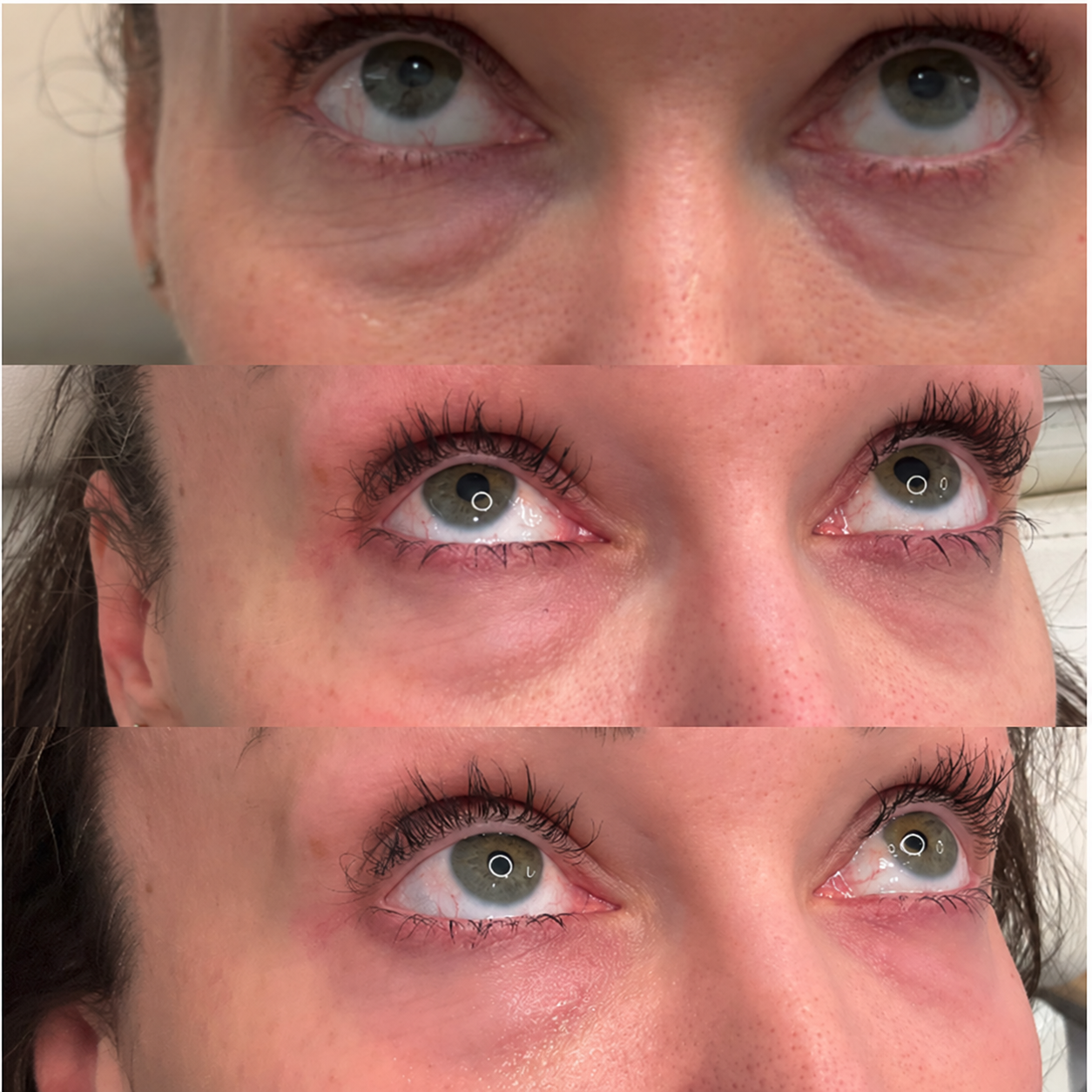
Individual response and treatment planning vary. This sequence is included for educational discussion during consultation.
Because Rejuran is delivered through multiple intradermal injections, visible injection-site marks and temporary skin reactions can occur. Your practitioner will explain the expected recovery for the proposed area and when you should contact the clinic.
Individual experiences vary. The presence, severity and duration of treatment-related effects cannot be predicted with certainty.
These effects may subside within several days. This is not a complete list of every possible risk or complication. Your practitioner will provide the product-specific information relevant to your treatment.
No. Rejuran is a professional-use medical device and is not available for purchase by the general public. It must be administered by a trained healthcare professional following consultation.
No. Suitability depends on individual assessment. Your practitioner will review your medical history, allergies, medicines, skin condition, treatment area and goals before advising whether treatment is appropriate.
Rejuran is delivered using multiple small injections, so discomfort can occur. Topical anaesthesia may be used where appropriate. Sensitivity and comfort vary between clients and treatment areas.
Response and timing vary between individuals and treatment plans. Your practitioner will explain what can reasonably be assessed, when review may be useful and why no particular outcome can be guaranteed.
Rejuran consultations are available at selected Avesa Health locations. Treatment and practitioner availability can vary, so confirm your preferred location when booking.
Discuss the area you would like assessed, learn whether Rejuran is suitable and receive clear information about the proposed treatment, likely recovery, alternatives and cost before deciding.
For eye-area concerns, explore our Eye Treatments pathway to understand the broader assessment options.